Dmv Permit Test 36

By Teacher David Global  •  Free

1. Which drugs may have an effect on your ability to drive?
A. Over-the-counter allergy and cold medication
B. Prescription headache medication
C. Illegal substances
D. All of the above
2. A driver entering interstate traffic from an entrance or acceleration ramp:
A. Should yield to drivers already on the interstate.
B. Has the right-of-way.
C. May force their way into traffic.
D. Can assume that other drivers will change lanes to make room.
3. Blood alcohol content (BAC) depends on each of the following, except:
A. Your body weight.
B. How much you drink.
C. How much time passes between drinks.
D. How physically fit you are.
4. At night, it is hardest to see:
A. Road signs.
B. Pedestrians.
C. Other motorists.
D. Street lights.
5. When approaching a school bus that is displaying flashing red lights, a driver should:
A. Sound their horn and pass slowly.
B. Stop, make sure it is safe to pass the bus, then proceed.
C. Slow down and proceed with caution.
D. Stop and remain stopped until the flashing lights extinguish.
6. Your vehicle strikes an unattended parked vehicle and you cannot locate the vehicle’s owner. You:
A. Have done as much as you can.
B. Must stay until the police arrive.
C. Must leave a written notice containing your name, your address, and the circumstances of the accident.
D. May go on your way.
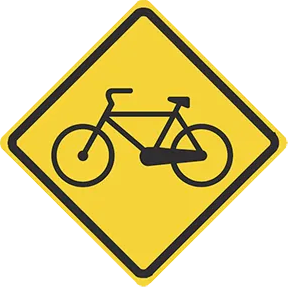
7. This road sign means:
A. Bicycle crossing.
B. Stop only if other cars are approaching.
C. Bicycle store.
D. Soft shoulders.
8. Which of the following statements is true?
A. Signal at least 100 feet before changing lanes to pass and ensure there is no oncoming traffic.
B. Use your mirrors and look over your left shoulder to check your blind spot when passing to the left.
C. When passing, wait until you can see both headlights of the passed car in your rearview mirror before returning to your original lane.
D. All of the above.
9. You must submit proof of insurance to the DMV within 15 days of a crash in which you were involved:
A. Only if property damage exceeds $2,000.
B. If the crash results in personal injury, death, or property damage of at least $501.
C. Only if property damage exceeds $1,000.
D. Only if there is death or personal injury
10. When passing another vehicle on a road with two lanes traveling in opposite directions, you should:
A. Return to the driving lane when there's enough room between you and the vehicle you passed.
B. Remain in the left lane if you intend to turn left.
C. Return to the right side of the roadway immediately.
D. Drive in either lane.
11. If a transit vehicle is signaling to re-enter the main roadway following a stop, you must:
A. Honk to let them know you’re there.
B. Move to the left lane.
C. Yield.
D. Speed up to pass.
12. A red traffic signal light means that you must:
A. Stop at the stop line.
B. Stop before entering any crosswalk.
C. Stop before entering the intersection.
D. All of the above.
13. When driving in fog, you should use your:
A. Low beam headlights.
B. High beam headlights.
C. Parking lights.
D. Hazard flashers.
14. If worried, nervous, angry, or crying, a driver:
A. Will drive no differently than they would if they were thinking more clearly.
B. Can drive faster because they are more in touch with their senses.
C. Should take the time to focus on driving before starting the engine.
D. Should call a friend to vent while driving.
15. This green arrow on a lane use control signal means:
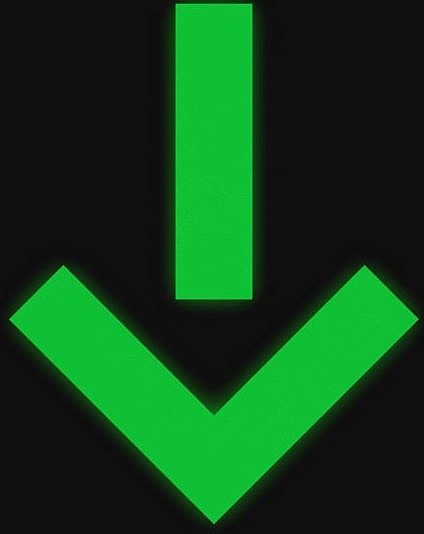
A. You may use this lane.
B. No traffic is allowed in this lane.
C. You have the right-of-way.
D. You must merge into this lane.
16. To avoid being in a truck or bus driver’s blind spot, you should:
A. Never pass them.
B. Avoid driving alongside them and avoid tailgating.
C. Flash your lights at them.
D. Sound your horn.
17. Drivers must yield to a pedestrian:
A. Even if the pedestrian crosses the street carelessly.
B. Only when the pedestrian is in a crosswalk.
C. Only if the pedestrian is on the same side of the road as the driver.
D. If the pedestrian uses a hand signal to ask oncoming drivers to stop.
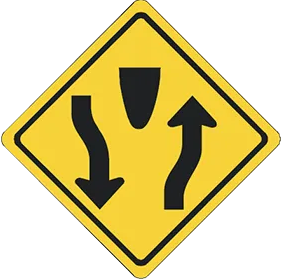
18. This sign means:
A. One-way traffic.
B. Divided highway ends.
C. Two-way traffic.
D. Keep left.
19. What does an orange-colored sign indicate?
A. The start of a no passing zone.
B. A railroad crossing is ahead.
C. A school zone is ahead.
D. The presence of construction work.
20. Drinking coffee after drinking alcohol:
A. Decreases blood alcohol concentration.
B. Cancels the effect of the alcohol.
C. Has no effect on blood alcohol concentration.
D. Increases blood alcohol concentration.