Dmv Permit Test 35

By Teacher David Global  •  Free

1. Slow down, yield, and be prepared to stop for pedestrians:
A. Only if a traffic light is yellow or red.
B. As they are crossing or walking on the roadway.
C. Only if they are in marked crosswalks.
D. Only if they are crossing the roadway.
2. A steady yellow light at an intersection means:
A. Go.
B. Yield to other cars.
C. Slow down and prepare to stop.
D. Stop.
3. What may help drivers conserve gasoline?
A. Sitting in their driveways with their cars running.
B. Accelerating quickly.
C. Slowing down gradually.
D. Braking abruptly.
4. Which of the following must you obey over the other three?
A. A steady red light
B. A police officer
C. A stop sign
D. A flashing red light
5. When you want to make a right turn, your car must be:
A. Near the center of the street.
B. Close to the left side of the street.
C. Close to the right side of the street.
D. Past the center of the intersection when you begin to turn.
6. When making a right turn on a green light, you must:
A. Maintain your normal driving speed.
B. Stop and look for nearby police cars.
C. Yield to pedestrians.
D. Increase your normal driving speed.
7. When you are being tailgated:
A. Move over to the right, if there is an open lane to your right.
B. If there is not an open lane to your right, wait until the way is clear ahead and reduce your speed slowly to encourage the tailgater to drive around you.
C. Never slow down abruptly.
D. All of the above.
8. You are driving when your power steering stops working. You should:
A. Honk your horn and turn off the ignition.
B. Turn on your hazard lights and brace yourself.
C. Work hard to steer, reduce your speed, drive to a safe area, and stop.
D. Slam on your brakes.
9. If your wheels drop off the pavement and onto the shoulder of the road, you should:
A. Brake hard and turn sharply back onto the pavement.
B. Stop your car on the edge of the road.
C. Slow down and very carefully turn back onto the pavement.
D. Maintain your speed and turn sharply back onto the pavement.
10. When the driver behind you wants to pass, you should:
A. Speed up.
B. Go the same speed.
C. Slow down to allow room in front of your vehicle for the other driver to complete the pass easily.
D. Change lanes.
11. You cannot pass safely on a two-way, two-lane street unless:
A. You are able to clearly see the road ahead.
B. You can return to your lane before meeting oncoming traffic.
C. Your vehicle is capable of the speed necessary to pass.
D. All of the above.
12. When parked facing downhill, the front wheels of your vehicle should be:
A. Turned toward the curb or shoulder.
B. Pointed straight ahead.
C. Aiming any direction.
D. Turned away from the curb.
13. Which of the following recommendations does not promote safe night driving?
A. Keep your windshield clean.
B. Be aware that tinted windows reduce visibility in the dark.
C. Carry a flashlight in your vehicle.
D. Look into the headlights of oncoming vehicles.
14. As alcohol builds up in your blood, it:
A. Slows down your reactions.
B. Makes you feel less confident.
C. Begins to metabolize itself more quickly.
D. Decreases the number of driving errors.
15. If you become stranded in a snowstorm, the best thing to do is to:
A. Get out of the car and go for help.
B. Lay down in your car and go to sleep.
C. Walk into the road and get the attention of other drivers.
D. Stay in the car, as you are most likely to be found when you stay in your vehicle.
16. To check your blind spot when changing lanes to the left, you should glance:
A. Over your right shoulder.
B. At your side mirror.
C. Over your left shoulder.
D. At your rearview mirror.
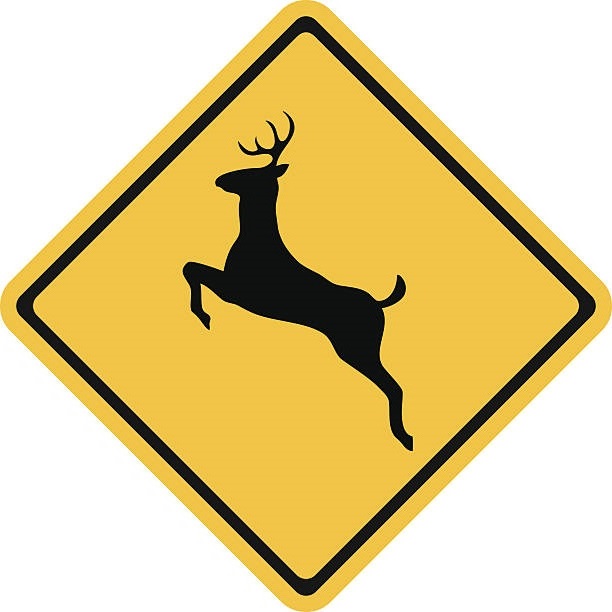
17. This road sign means:
A. Hunting area.
B. State park.
C. Deer crossing.
D. Wildlife preserve.
18. You must yield for emergency vehicles:
A. Under no circumstances.
B. When you see a flashing red or blue light or hear a siren.
C. Only when other vehicles yield.
D. None of the above.
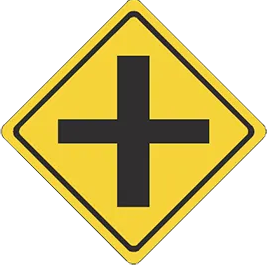
19. This sign shows one type of:
A. Intersection.
B. Road curve.
C. Right turn.
D. Lane change.
20. You may pass another vehicle:
A. In a curve or on a hill because the chance is small that another vehicle is coming.
B. By using the shoulder of the highway.
C. If your lane is next to a solid yellow line and the passing lane is clear ahead.
D. None of the above.