Dmv Permit Test 23

By Teacher David Global  •  Free

1. When used on roadways, bicycles are considered:
A. Hazards.
B. Vehicles.
C. Dangerous.
2. There are oncoming vehicles to your left and a row of parked vehicles to your right. You should steer:
A. Closer to the oncoming vehicles than the parked vehicles.
B. Closer to the parked vehicles than the oncoming vehicles.
C. A middle course between the oncoming and parked vehicles.
3. A flashing red traffic light at an intersection means:
A. The same thing as a yield sign.
B. The light is about to turn green.
C. The same thing as a stop sign.
4. If you can see that the roadway up ahead is covered by heavy smoke, you should:
A. Turn on your four-way flashers and continue.
B. Reduce your speed, move as far to the right as possible, and stop off the roadway.
C. Turn on your high beam headlights and continue.
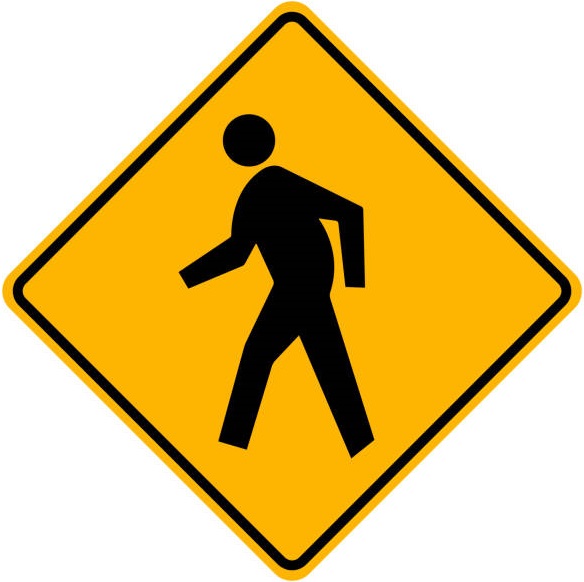
5. This sign means:
A. Pedestrian crossing.
B. Side road.
C. Railroad ahead.
6. Large trucks are likely to lose speed when:
A. Driving up long or steep hills.
B. Driving in long, gradual curves.
C. Driving down long, gradual hills.
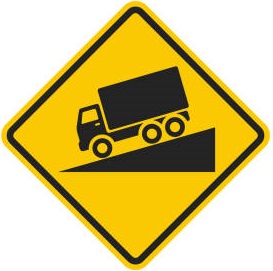
7. This sign indicates that:
A. There is a steep hill ahead.
B. No trucks are allowed on the upcoming hill.
C. A logging road is ahead.
8. If you plan to pass another vehicle, you should:
A. Not assume the other driver will make space for you to return to your lane.
B. Assume the other driver will let you pass if you use your turn signal.
C. Assume the other driver will maintain a constant speed.
9. When driving in fog or mist, never put your headlights on the high beam setting because:
A. The light will reflect back into your eyes.
B. Approaching vehicles might not see you.
C. Vehicles behind you may follow too closely.
10. This sign means:
A. Trucks entering.
B. Truck exit only.
C. Steep downgrade ahead.
11. If you are being followed too closely on a two-lane road:
A. Reduce your speed slowly to encourage the tailgater to drive around you.
B. Speed up to increase the distance between you and the other car.
C. Apply your brakes to slow down, then resume your original speed.
12. Yellow lines separate:
A. Traffic lanes on one-way streets.
B. Traffic moving in opposite directions on two-way roads.
C. All carpool lanes from regular traffic lanes.
13. When passing another vehicle, you should return to your original lane when:
A. You can see both headlights of the passed vehicle in your rearview mirror.
B. You have cleared the front bumper of the passed vehicle.
C. You are 50 feet in front of the passed vehicle.
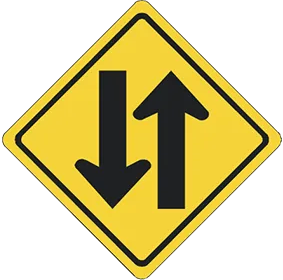
14. This sign means:
A. You can travel in either direction in this lane.
B. There is two-way traffic.
C. You are approaching a divided high
15. A flashing yellow light at an intersection means you should:
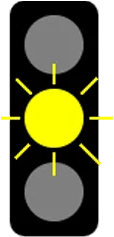
A. Slow down and proceed with caution.
B. Come to a complete stop as quickly as possible.
C. Stop and proceed only when the intersection is clear.
16. As you approach the top of a hill, you should:
A. Speed up slightly.
B. Prepare to stop, if needed.
C. Maintain a steady speed.
17. You should not use your horn:
A. When visibility ahead is limited.
B. If you might hit another vehicle.
C. Near blind pedestrians.
18. Alcohol in any concentration is:
A. A stimulant.
B. A depressant.
C. Neither of the above.
19. Having a driver license is a:
A. Requirement.
B. Privilege.
C. Right.
20. You have allowed the wheels of your vehicle to run off the edge of the pavement. What should you do first?
A. Turn the front wheels slightly to the left to edge the car back onto the pavement.
B. Hold the steering wheel firmly, release the gas pedal, and gently apply the brakes.
C. Apply the brakes and turn the front wheels sharply to the left
21. You want to turn left at an upcoming corner. Yield the right-of-way to:
A. Oncoming vehicles also turning left.
B. All approaching vehicles.
C. Pedestrians on the sidewalk waiting for a "Walk" signal.
22. Vehicles stopped behind a school bus with its red lights flashing must remain stopped until:
A. All students are off the bus.
B. The stop arm is retracted.
C. The stop arm is retracted and the bus resumes motion.
23. When turning left from a two-way street onto a one-way street, you should:
A. Turn into any lane.
B. Turn into first lane.
C. Turn into second lane.
24. A broken yellow centerline means that:
A. Passing is not permitted.
B. Passing on the right is permitted when the way ahead is clear.
C. Passing on the left is permitted when the way ahead is clear.
25. You hit a parked vehicle and can't find the owner. What must you do?
A. Call your insurance company when you get home.
B. Wait for the owner to return.
C. Leave a note with your name and address on the parked vehicle.
26. While in a motor vehicle on a highway, it is:
A. Illegal to either drink from or possess open containers of alcohol.
B. Legal to drink alcohol if you're not driving.
C. Legal to drink alcohol if you're driving but not drunk.
27. If you come to an intersection and your view to the side is blocked, you should:
A. Slow down and look both ways.
B. Maintain your speed and look both ways.
C. Stop, then inch forward until you can see clearly in both directions.
28. Alcohol is:
A. A stimulant.
B. An antihistamine.
C. A depressant.
29. If you have a sudden tire blowout:
A. Use the brakes lightly.
B. Pump the brakes.
C. Apply the brakes firmly.
30. This sign means:
A. No passing zone.
B. Slow-moving vehicle.
C. Two-way traffic.
31. You should increase the distance between your vehicle and the vehicle ahead when you:
A. Are following a small passenger vehicle.
B. Are being tailgated by another driver.
C. Are driving more slowly than the posted speed limit.
32. In inclement weather, you should:
A. Steer off the road.
B. Drive in a low gear.
C. Steer and brake smoothly.
33. A driver who leaves a gas station without paying for gas will:
A. Have their license suspended.
B. Be given a warning.
C. Not face any consequences.
34. At an intersection with a yield sign, you:
A. Must yield the right-of-way to cross traffic that is close enough to cause conflict.
B. Must yield to vehicles only on your right.
C. Should slow down but never stop.
35. When driving at night, you should:
A. Always use your high beams.
B. Look directly at the headlights of an oncoming vehicle.
C. Increase your following distance.
36. Unless otherwise posted, the speed limit on the interstate is:
A. 55 mph.
B. 70 mph.
C. 80 mph.
37. In traffic moving at 50 to 55 mph, you are least likely to have an accident if you:
A. Drive a few miles per hour faster than most other vehicles.
B. Stay within that speed range.
C. Drive a few miles per hour slower than most other vehicles.
38. When approaching an intersection that is controlled by a flashing red traffic signal, you must:
A. Come to a complete stop, yield to oncoming traffic or pedestrians, then proceed.
B. Reduce your speed and proceed with caution.
C. Come to a complete stop and remain stopped as long as the light is red.
39. A broken yellow centerline indicates that:
A. Passing is not permitted.
B. Passing on the right is permitted when the way ahead is clear.
C. Passing on the left is permitted when the way ahead is clear.
40. If the rear of your vehicle is skidding to the left, you should:
A. Not turn your steering wheel.
B. Turn your steering wheel to the left to correct the skid.
C. Turn your steering wheel to the right to correct the skid.