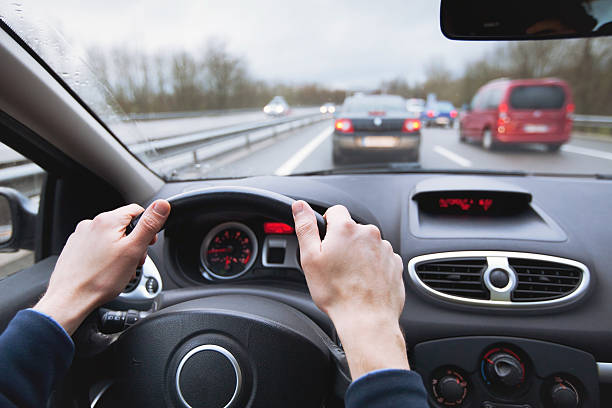
Speed Control
Controlling your speed is one of the most important aspects of safe driving.
Reckless driving and over-speeding are major contributors to traffic accidents and fatalities.

Observe speed limits while considering road conditions, traffic, and surroundings.
High speeds reduce reaction time and increase the severity of accidents.
Pedestrians and vulnerable road users are at higher risk when vehicles are speeding.
EFFECTS OF POOR SPEED CONTROL
Harder to stay in your lane, especially on corners or bends.
Less time to respond to road, traffic, or weather changes.
Greater chance of missing hazard or traffic signs.
Increased fuel consumption and vehicle wear.
THE 4-SECOND RULE
Maintain at least a 4-second gap from the vehicle ahead.
Method: After the vehicle passes a fixed landmark, count: “one thousand and one… one thousand and four.”
If you pass the landmark before finishing the count, increase your following distance.
BRAKING AND STOPPING DISTANCES
Thinking distance is the distance a vehicle travels from the moment a driver sees a hazard to the moment they begin to apply the brakes.
In other words, it is the distance covered during the driver’s reaction time.
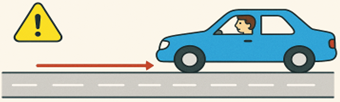
WHAT HAPPENS DURING THINKING DISTANCE?
When a hazard appears:
Your eyes see the danger
Your brain recognizes the danger
You decide to brake
Your foot moves to the brake pedal
All this takes time, usually about 1 second for most alert drivers.
During this second, the vehicle keeps moving at full speed.
This is the thinking distance.
WHAT AFFECTS THINKING DISTANCE?
Thinking distance increases if the driver is:
Tired or fatigued
Distracted (phone, radio, passengers)
Under the influence of alcohol/drugs
Elderly or sick
Driving at higher speeds
It also increases at night because hazards are harder to see.
APPROXIMATE THINKING DISTANCES BY SPEED
(Using average reaction time of 1 second)
At 20 km/h → 6 meters
At 40 km/h → 12 meters
At 60 km/h → 18 meters
At 80 km/h → 24 meters
At 100 km/h → 30 meters
Higher speed = longer thinking distance.
WHY THINKING DISTANCE MATTERS
It shows that even a quick reaction still requires distance.
Drivers must keep a safe following distance.
Helps prevent rear-end collisions.
Part of total stopping distance.
BRAKING DISTANCE
Braking distance is the distance a vehicle travels from the moment the brakes are applied until the vehicle comes to a complete stop.
It begins after the thinking distance.
WHAT HAPPENS DURING BRAKING DISTANCE?
Once the driver presses the brake pedal:
The braking system applies pressure to slow the wheels
The tires grip the road (traction)
The vehicle gradually loses speed
The vehicle fully stops
The distance covered during this entire slowdown is the braking distance.
WHAT AFFECTS BRAKING DISTANCE?
Braking distance depends on vehicle condition, road condition, and speed.
Vehicle factors
Condition of brake pads (worn pads = longer distance)
Condition of tires (bald tires = less grip)
ABS (Anti-lock Braking System) improves control
Weight of vehicle (heavier = longer distance)
Road conditions: These reduce friction and increase braking distance.
Wet or slippery roads
Muddy or sandy surfaces
Gravel or loose stones
Downhill slopes
Oil spills on the road
Speed: Speed is the biggest factor.
Braking distance increases with the square of the speed.
This means:
If speed doubles → braking distance becomes 4 times longer
If speed triples → distance becomes 9 times longer
APPROXIMATE BRAKING DISTANCES BY SPEED
(Assuming dry road & good brakes)
At 20 km/h → 6 m
At 40 km/h → 12 m
At 60 km/h → 24 m
At 80 km/h → 38 m
At 100 km/h → 55 m
Wet roads can double these numbers.
WHY BRAKING DISTANCE MATTERS
Helps drivers choose a safe following distance
Prevents skidding and collisions
Helps understand total stopping distance
Important for driving tests and defensive driving
STOPPING DISTANCE AND THINKING DISTANCE
Stopping distance is the total distance a vehicle travels from the moment a driver notices a hazard to the moment the vehicle comes to a complete stop.
It includes two parts:
Thinking distance: Distance traveled before the brakes are applied while the driver is reacting.
Braking distance: Distance traveled after braking begins until the car fully stops.
Formula: Stopping Distance = Thinking Distance + Braking Distance
WHY STOPPING DISTANCE IS IMPORTANT
Shows how far a vehicle needs to stop safely
Helps drivers judge safe following distances
Helps prevent rear-end crashes
Used in driving tests and defensive driving lessons
WHAT AFFECTS TOTAL STOPPING DISTANCE?
Driver factors
Tiredness or fatigue
Distraction (phone, radio, passengers)
Alcohol or drugs
Visibility (night, fog, glare)
Vehicle factors
Brake condition
Tire condition and pressure
ABS vs non-ABS braking
Vehicle weight
Road & weather conditions
Wet, muddy, or icy roads
Gravel or loose surfaces
Going downhill
Oil spills on the road
These increase braking distance significantly.
TYPICAL STOPPING DISTANCES BY SPEED
(Average driver, dry road)
20 km/h → 12 m
40 km/h → 24 m
60 km/h → 42 m
80 km/h → 62 m
100 km/h → 85 m
Wet roads can make stopping distance twice as long.
KEY IDEA TO REMEMBER
Even if your reaction is fast, your vehicle still needs time and distance to stop.
Always keep a safe following distance.
The faster the speed, the greater the distance required.
BRAKING SYSTEMS
Disc brakes, drum brakes, handbrakes are the main types.
Braking transfers vehicle weight forward, so front brakes are most effective.
Handbrake controls the rear brakes, mainly used for parking or emergency stops.
FREEWHEELING / COASTING
Occurs when the car moves without engine power (clutch depressed).
Risks of freewheeling
Reduced control over the vehicle.
Inability to accelerate quickly if needed.
Increased brake wear.
No significant fuel savings.
Progressive braking is safer and more effective than freewheeling.
Maintaining proper speed, safe following distances, and effective braking ensures better vehicle control, reduced accidents, and safer roads for everyone.
CONDITIONS OF CARRIAGE
Conditions of carriage define the rights of passengers or customers and the responsibilities of drivers and operators.
They ensure safety, fairness, and accountability during transport.
KEY POINTS FOR PUBLIC SERVICE VEHICLES (PSVS)
Liability: Provide a clear statement of the driver’s or operator’s liability in case of accidents, loss, or damage.
Fare/ticket information: Display fare or ticket prices, including any exceptions or special charges.
Code of conduct: Follow and enforce a clear code of conduct for drivers and staff.
Restricted items: Clearly outline items that are not allowed on board.
Lost property procedures: Establish a procedure for handling lost or misplaced items.
Contact details: Include the name, contact number, and address of the vehicle owner or service operator for complaints or inquiries.
Do not carry more passengers or goods than legally allowed.